CV Versus Resume: Which Should You Send?
Key takeaways
- **Follow the vacancy’s instructions first.** The role and requested evidence matter more than the document’s name.
- For most commercial roles, send a focused employment document. Use an academic CV when employers request research, publications or teaching history.
- Renaming an academic CV does not turn it into a resume. Select and reorganize the content for the target role.
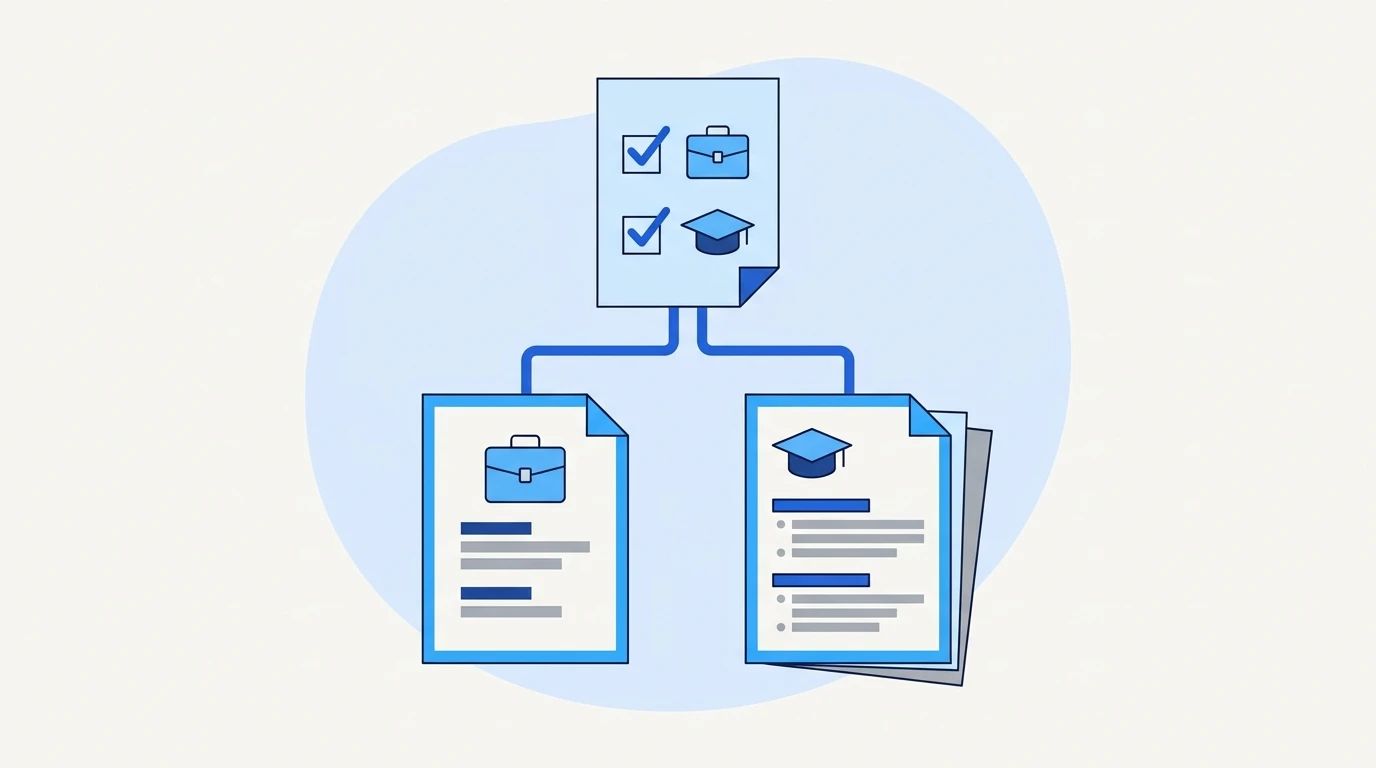
The CV versus resume choice depends on the job and country. For most US and Canadian industry jobs, send a targeted resume. Academic applications often require a detailed CV. Elsewhere, “CV” may mean a job-focused document. Use the comparison and examples below to choose what to send.
CV Versus Resume: Compare the Purpose and Content
Choose using the employer’s instructions first, followed by the role’s purpose and local terminology. Length follows the evidence requested. Adding pages to an employment CV does not make it more appropriate, and a short academic CV can be suitable early in a research career.
The central difference between CV and resume formats is their scope. UC Davis distinguishes a full academic history from a concise summary of qualifications. However, an ordinary employment CV can serve the same purpose as a resume.
Use this table as a decision worksheet. Fill the empty column with requirements taken directly from your vacancy.
| Decision criterion | Employment resume or job-focused CV | Academic CV | Your application |
|---|---|---|---|
| Main purpose | Demonstrate fit for a specific job | Document relevant academic and scholarly credentials | |
| Strongest evidence | Relevant employment, achievements and skills | Research, teaching, publications and related academic work | |
| Coverage | Select experience that supports the vacancy | Include the academic record requested by the institution | |
| Length | Keep the document concise and respect stated limits | Allow space for the required scholarly record, within application limits | |
| Tailoring | Select and reorder evidence for the job | Emphasize relevant academic work while retaining any requested complete lists |
For entry-level resumes, Michigan State University gives a typical length of one page. An academic CV grows with your scholarly record, although an application may still impose a page limit. Neither document benefits from irrelevant detail.
What Does “CV” Mean in Different Countries?
“CV” can describe either an academic record or a focused employment document. A UK employer may request a CV for an ordinary commercial vacancy where a US employer would request a resume. The label alone cannot settle the choice.
For a vacancy in the United Arab Emirates or Saudi Arabia, read “CV” alongside the actual requirements. A sales vacancy requesting employment history calls for different evidence from a university position requesting publications. Avoid importing an academic template simply because the advert uses “CV.”
We recommend treating the vacancy’s requested content as the strongest signal. Country conventions help interpret the wording, but a clear request for a research record should outweigh a general assumption about local terminology.
What Would You Send for Each Job?
The same background can support different documents. Imagine you have a biotechnology degree, laboratory experience and a journal article. You are considering a quality-assurance vacancy in Dubai and a university research fellowship in the US.
For the Dubai commercial role, prepare a targeted employment CV unless the instructions say otherwise. Put relevant laboratory work ahead of a lengthy publication section. Explain the procedures you followed and how you documented deviations, provided those responsibilities match your actual work.
If the vacancy requires good manufacturing practice (GMP) experience, make your relevant work or training easy to locate. Naming the document correctly will not compensate for a missing mandatory qualification. Check eligibility before spending time expanding the application.
For the research fellowship, send an academic CV if requested. Give research projects enough space to explain your contribution and methods. Include the journal article as a full citation, and add teaching experience where relevant to the fellowship criteria.
Skip the full academic version for the commercial role unless the employer requests it. For the fellowship, avoid compressing requested research evidence into a short employment summary merely to follow a resume convention.
How Do You Turn an Academic CV Into a Resume?

Convert an academic CV by selecting evidence for the target job, then changing its order and level of detail. Save a separate version so your academic record remains available. Simply changing the filename leaves the employer with the same content to assess.
For an industry application, bring relevant employment or applied research experience forward. Condense publication details when the article mainly demonstrates subject knowledge. Retain full citations when authorship or research output is central to the advertised work.
Describe research through its relevant contribution. A laboratory project might demonstrate troubleshooting, for example, while a teaching appointment might demonstrate explaining technical material to non-specialists. Use those connections only when they match the vacancy and your actual responsibilities.
Document choice also differs from technical readability. For layout guidance, use our advice on writing a CV that is easy to scan because a suitable document can still have an unclear reading order in an applicant tracking system, the software employers use to manage applications.
If you plan to pay for the conversion, compare resume writing services and costs before commissioning the work. Specify whether you need a targeted employment document or an academic CV, along with the target role and country.
What If the Application Instructions Are Unclear?
When the document choice is unclear, ask what content the employer expects. The UNC Writing Center recommends following application instructions or contacting the hiring organisation when deciding between a CV and resume. A short clarification can prevent substantial rewriting.
A generic upload field labelled “Resume” is weaker evidence than a detailed vacancy requesting publications and teaching history. Follow the substantive requirements and accepted file format. If the instructions conflict, use the named recruitment contact to clarify them.
You can adapt this message:
Hello [Name],

The advert for [role title] requests a CV. Would you prefer a concise employment document or a full academic CV covering research and publications?

Thank you,
[Your name]
If no reply arrives before the deadline, follow the most specific written instructions available. For a commercial vacancy without academic requirements, we recommend a focused employment document. For an academic vacancy requesting a scholarly record, preserve that evidence.
Sources and references
Frequently asked questions
Does a CV or resume replace a cover letter?
No. A CV or resume records your qualifications, while a cover letter explains your interest and suitability for that particular opportunity. Submit a cover letter when the application requests one.
Should I attach both a CV and a resume?
Usually, send the document the employer requests. Attach both only when the instructions explicitly require them or a recruiter confirms that separate versions are useful. Duplicate attachments can leave the reviewer unsure which version to assess.
Should a CV include a photograph?
The word “CV” does not automatically mean you should include a photograph. Check the employer’s requirements and relevant local hiring guidance before adding one. Avoid copying personal-information fields from an unfamiliar country’s template without checking their purpose.
For the Dubai quality-assurance vacancy, send the employment CV with required credentials clearly visible. Joblancer provides country-specific CV rewriting by resume experts, and you can contact our team about adapting your CV. No format guarantees employment, so confirm requirements through the employer’s official instructions before submitting.
This article is general information for education. It is not legal, immigration, tax or HR advice, and it does not guarantee employment or a visa. Check important points with official sources or a qualified professional.